My story of Rock Music
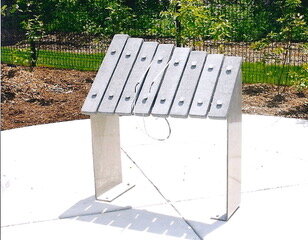
Litthophone at Garoon Gateway to Science, Lake Zurich , Illinois
Litho is Greek for stone, and phone is sound, so a lithophone is a musical instrument made from stone. They are one of the most ancient instruments, and in Viet Nam a stone instrument called a “dan da” was found that is believed to be over 3,000 years old. In China the sound of stone is as elemental as metal or wood, and the Bianqing was essential to imperial court and ritual music. It consists of a set of L-shaped jade stones (usually 16) cut to varying thicknesses to produce different pitches. Mastery of the instrument was a mark of a distinguished gentleman, and even Confucius was known to be an expert player.
Until as recently as 2013, archeologists had been misidentifying some sets of stones found in North American prehistoric sites, as grinding or digging tools. Duncan Caldwell revealed through microscopic analysis of wear patterns, that they had instead been used to make music. Now we know ancient civilizations around the world made and used stone instruments. There is even a recent theory that Stonehenge was a musical instrument
The first documented use of lithopones in Western Civilization is from Peter Crosthwaite in his memorandum on 11 June 1785. He described them as "Music Stones of Skiddaw”, rediscovering the lithophone and creating one that stayed at a museum in Keswick England. In 1840 Joseph Richardson, a stone mason and self taught musician, built an eight octave instrument he called a “Rock Harmonicon”. He and three of his sons toured throughout Great Britain and Europe, and played at Buckingham Palace for Queen Victoria in 1848.
Composer Carl Orff commissioned the design and construction of a lithophone for his choral work Antigonae, which had its premiere in 1949. Assisting Orff with this instrument, which he called a steinspiel, was a young engineer called Klaus Becker-Ehmck and for him this began a career designing and manufacturing percussion instruments. The company he founded, still operating today, took its name from the year it was established, Studio 49.
Stones that ring when struck with a hammer can be found in natural settings such as Ringing Rocks State Park in Buck’s County, Pennsylvania. and near Butte, Montana. I visited Ringing Rocks Park in 2018, and discovered about half of the boulders rang, while the others emitted a dull thud, like most stones. It was easy to tell which was which, because the ones that rang were covered with hammer marks, and the others had very few scars.